
Production of dry-type transformers: reliable, safe and oil-free
2026-04-12
content
Dry transformers are not a backup option. They are the choice for facilities where every drop of oil, every gram of fire risk and every minute of downtime is critical. We have been producing dry-type transformers for 12 years. During this time, we have seen them installed in the basements of Moscow shopping centers, on the roofs of Novosibirsk residential complexes, in clean areas of pharmaceutical production and in modular substations in the North Caucasus. And every time the reason is the same:reliable, safe and oil-free.
Why “no oil” is not a compromise, but an engineering solution
Oil transformers operate stably - but only until a leak, overheating or breakdown occurs. In one of the projects in Yekaterinburg, the client ordered an oil apparatus for a distribution substation in a historical building. After 18 months - an accident in the oil receiver, a leak into the basement, the elevators stopped and evacuation. Not because of poor quality oil. Due to physics: oil expands when heated, puts pressure on seals, and ages under the influence of oxygen and moisture. A dry transformer does not pose such a risk. Its insulation is epoxy resin or air gap. No containers. No fumes. There are no requirements for Class G fire barriers. Only proven thermal dissipation calculations and certified materials.
In practice this means:
- Installation in residential and public buildings without approval from the Ministry of Emergency Situations for Fire Safety;
- Service life 30+ years, subject to temperature conditions (up to +40°C ambient);
- Efficiency up to 98.7% - especially at loads of 60–85% of the nominal;
- No need for routine replacement of the insulating medium.
Production of dry-type transformers - where precision replaces volume
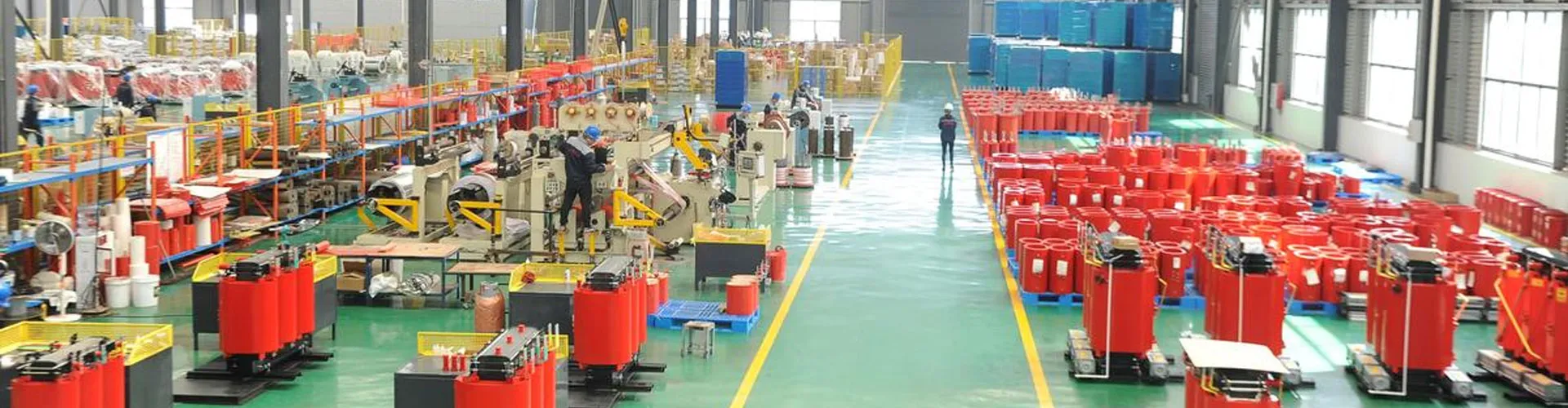
Some people think: “dry = easier.” This is a dangerous misconception. The absence of oil does not eliminate the insulation requirements - it strengthens them. At our production in Wenzhou, each winding undergoes three-stage control:
- Before winding, laser check the diameter and uniformity of the enameled wire (tolerance ±0.008 mm);
- After winding - measurement of interturn capacitance and frequency analysis of impulse response (PIV test);
- After pouring with epoxy, scanning ultrasonic flaw detection is performed to identify microvoids and delaminations.
We do not use “universal” blanks. Each model has its own vacuum filling mode: 18 minutes at 0.1 mbar, then 12 hours at +135°C. This eliminates bubbles and guarantees adhesion of the 3.2 mm thick layer. This is why our transformers can withstand a voltage test of 36 kV (for 10 kV class) without breakdown - even after a thermal shock cycle from -40 to +85°C.
What is really important when choosing - and what is often overlooked
Clients often ask: “Which insulation class to choose - F or H?” The answer depends not on marketing, but on operating conditions. Class F (155°C) - sufficient for air-conditioned office buildings. Class H (180°C) - required where there is no ventilation: in KRUN cabinets, in open areas in Astrakhan, in modular substations in Yakutia. But something else is more important: how is overload protection ensured? All our transformers are equipped with digital Pt100 sensors at three winding points. Data is output to the SCADA system - not through a “black box”, but via the standard Modbus RTU protocol. This allows you to quickly respond to deviations 5–7% earlier than the thermal protection relay operates.
Another hidden factor is the noise level. At a power of 1000 kVA, the oil transformer makes 55–60 dB noise. Dry - 65–72 dB. But we have solutions: a special frame with damping inserts and optimized magnetic circuit geometry reduce the level to 58 dB. This is essential for schools, hospitals and hotels.
The production of dry-type transformers is not an assembly, but a responsibility for the circuit
Electrical equipment does not operate in a vacuum. It is built into the system: from the power source to the end user. That's why we don't just supply transformers. We check compatibility with your circuit breakers, coordinate connection points with your switchgear design, help calculate the thermal load on the room and prepare documentation for Rostechnadzor - including test reports in accordance with GOST R 52736–2007 and certificates of conformity TR TS 004/2011.
Today we produce dry transformers from 25 to 2500 kVA, with a voltage of 6–35 kV on the HV side and 0.4–1 kV on the LV side. All of them undergo 100% output testing: 120% load cycle for 2 hours, checking no-load and short circuit losses, measuring transformation ratio with an error of ±0.25%. Not a single device leaves the workshop without the signature of the chief engineer and a QR code leading to a page with complete test data.
The production of dry-type transformers is not a rejection of tradition. This is a transition from protecting against consequences to preventing causes. From reactive maintenance to predictive reliability. From compromises to technical solutions that work as intended. And if your next project requires confidence in every volt, every second of uninterrupted operation - start with the right choice of insulation. No oil. Without a doubt.