
Three-phase dry-type transformer: a reliable solution for industry
2026-05-23
content
A three-phase dry-type transformer is not just a component of the electrical network. This is the point of failure in production, where stopping a line costs tens of thousands of rubles per hour. We saw how oil analogues failed when overloaded in the workshop of a foundry near Yekaterinburg - smoke, the smell of burnt insulation, a two-day downtime. A dry transformer of the same design worked without failures for 17 months in a row. Why? Because it does not require oil, is not afraid of dust, does not require a sealed room and can withstand short-term overloads up to 150% of the nominal value - if you choose the right type, power and protection class.
When a three-phase dry transformer becomes the only solution
It does not replace oil in 110 kV power lines. But where safety, compactness and operational flexibility are important - in workshops, transformer substations on construction sites, pumping stations, oil and gas production facilities - a dry transformer is often the best choice. Its main advantages are not in marketing slogans, but in physics: the absence of flammable dielectric eliminates the risk of fire, air cooling allows it to be installed in rooms without oil receivers, and the design with epoxy filled windings ensures stable operation at humidity up to 95% and temperatures from −40 °C to +40 °C.
We tested this in practice: in a project to modernize a distribution point at an enterprise in the Krasnoyarsk Territory, the client initially planned an oil transformer. After analyzing the conditions - high humidity, frequent voltage fluctuations, lack of a separate room - we proposed a 630 kVA three-phase dry transformer with natural air cooling (AN) and insulation class F. Installation took 8 hours. After three weeks - not a single failure, even with a sharp drop in voltage to 185 V at the input.
What really affects service life - and what you shouldn’t be afraid of
The average service life of a high-quality three-phase dry transformer is 25–30 years. But not under any conditions. The main “enemies” are not overload, but the accumulation of dust in the cooling channels and condensation on the surface of the windings. We observed a 22% reduction in heat dissipation for equipment installed in an unheated room without ventilation - winding temperatures regularly exceeded +110 °C. The solution was simple: we added forced cooling (AF mode) and installed a humidity sensor with automatic activation of the heaters.
A common myth is that “dry-type transformers cannot be used in regions with an aggressive atmosphere.” This is not true. With the correct housing design (IP54 or higher), the use of corrosion-resistant materials and coatings such as polymer-epoxy resin, the equipment operates reliably even in port areas and chemical plants. For example, in one of the projects in the Murmansk region, we supplied a three-phase dry transformer with an aluminum housing anodized according to the military standard GOST R V 2.710-2021 - after 18 months of operation, no traces of corrosion were found.
How to choose - without overpayments and compromises
The choice begins not with power, but with conditions. Ask yourself four questions:
- Where will it stand?Inside the workshop, IP2X is sufficient. Outdoors or in an unheated room - minimum IP54 and anti-condensation heating system.
- What overloads are possible?For short-term peaks - class F (155 °C). For long-term - H (180 °C), but with mandatory control of the temperature of the windings.
- What noise level is acceptable?In office buildings or residential complexes - no more than 55 dB(A) at 100% load. This requires special acoustic insulation and vibration damping supports.
- Is integration into automated control system necessary?Modern models support Modbus RTU or RS-485 for transmitting data on temperatures, currents and protection status.
And yes, price is important, but not decisive. A cheap transformer with uncalibrated temperature sensors and uncertified winding insulation will cost more during the first emergency repair.
Reliability starts with production and ends with your experience
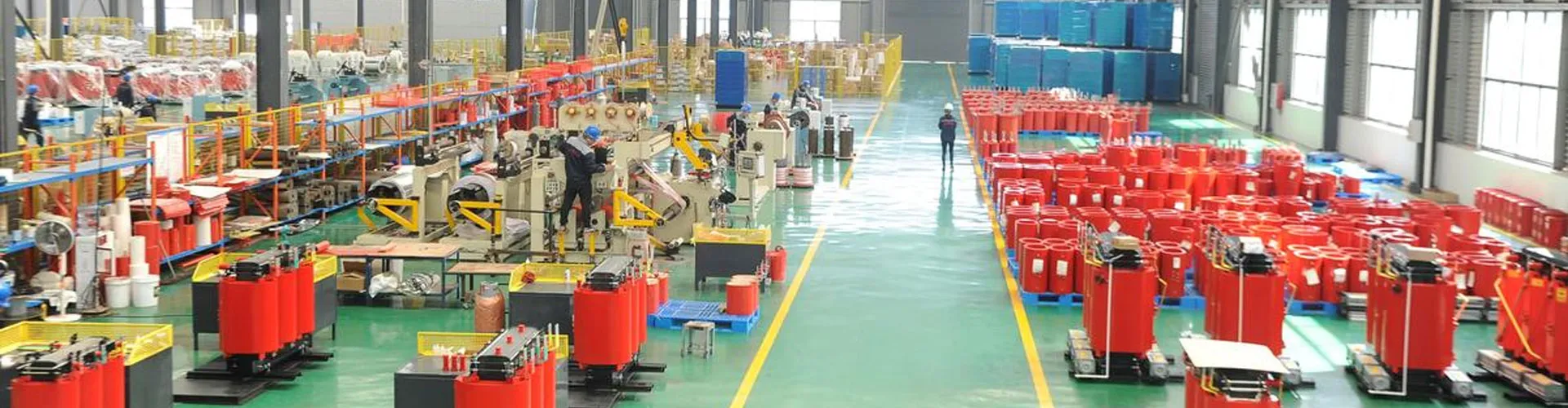
A three-phase dry transformer is not an assembly, but a system. From the quality of epoxy resin to the precision of winding, from the heat resistance of the frame to the repeatability of parameters during serial production. That is why Wenzhou Qiaonasen Electrical Equipment LLC locates production in Wenzhou, a city where more than 60% of Chinese electrical equipment exports are concentrated and there are 12 independent testing laboratories in accordance with GOST IEC 60076. Each product goes through 7 stages of control: from incoming testing of copper and epoxy to final testing for dielectric strength of 28 kV/min and thermal cycling from −40 °C to +120 °C.
Technical data sheets, connection diagrams and installation recommendations are available in Russian on the qnasen.ru website. But the main thing is support after the purchase: engineers help calculate the thermal load, coordinate parameters with the network and carry out commissioning. Because reliability is not a feature in a catalogue. This is what remains when the lights go out and the equipment continues to work.